
Asbestos management software
Asbestos management software for building portfolios
Identifying asbestos-containing materials is the beginning. The longer problem is keeping track of what was found, where it is, what evidence supports it, and what has changed since — across every building you are responsible for.
Towerforma keeps that information in a structured building record instead of a growing archive of assessment reports.
- Material-level records organized by room
- Assumed, sampled and confirmed kept distinct
- Evidence and photographs attached to the material
- Records updated after remediation or renovation
Pre-launch · In development with hazardous materials professionals
The difficulty
Managing asbestos across a portfolio is an information problem.
The technical facts about a building rarely change quickly. What changes is who knows them, where they are written down, and how many documents you have to open before you trust the answer.
Answers live in old reports
A question about one mechanical room means finding the right assessment among several, checking its scope, and hoping the room was included.
Scope varies by project
Pre-renovation assessments cover a floor. Full surveys cover a building. Neither is complete on its own, and together they overlap inconsistently.
Nothing reflects the removals
Materials get abated during projects, but the reports describing them stay in circulation, so out-of-date entries keep resurfacing.
The cost shows up as delay: a contractor waiting, a project on hold, or a duplicate assessment commissioned because the previous one could not be trusted quickly enough.
Locate
Know what is present and where.
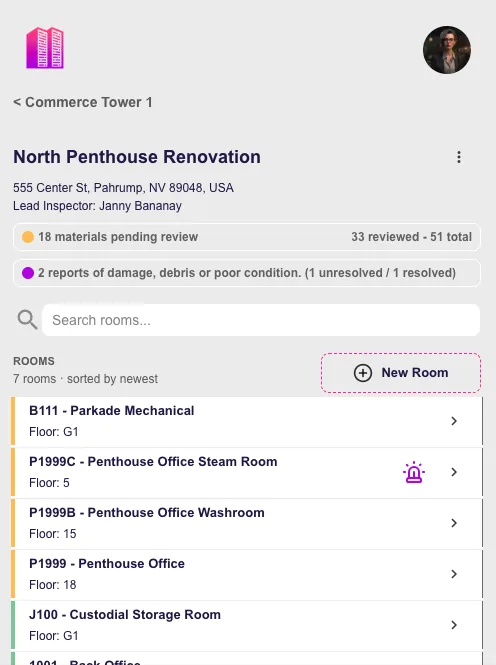
Location precision is the difference between a usable inventory and a general warning. Every entry belongs to a room, and every room belongs to a floor and a building.
Room-level entries
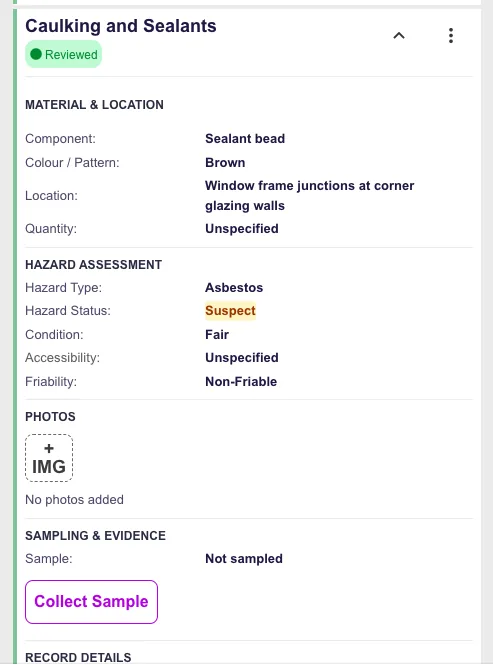
Material occurrences are recorded in the room where they exist, with a description of the specific location inside that room.
Status is explicit
Assumed, sampled and confirmed are separate states, so nobody has to infer certainty from the tone of a report sentence.
Quantity and extent
Recorded where it was observed, so scoping conversations start from something better than a guess.
Consistent descriptions
Materials described the same way across rooms and buildings, which is what makes portfolio-level questions answerable.
Evidence
Keep the evidence attached to the material record.
An entry is only as useful as the evidence behind it. When results and photographs sit in separate systems, every future question reopens the reconciliation work.
Analytical results in place
The result stays on the material record it belongs to, with its sample identifier and location.
Photographs retained
Images of the material and its room remain attached, which is often how a contractor identifies it on site.
Assessment provenance
Which inspection produced the entry, and when, stays visible on the record.
Condition information
Observed damage, debris or deterioration recorded against the specific occurrence.
Sampling history
Additional sampling adds to the record rather than replacing what was there before.
Exportable evidence
Structured records and organized photographs can be exported when they need to travel with a project.
History
Maintain historical information without burying the current state.
Facilities teams need today's answer. Consultants and legal reviews need the record of how that answer was reached. A structured inventory can serve both.
- Current status is what the record shows first.
- Earlier assessments and results remain attached to the material.
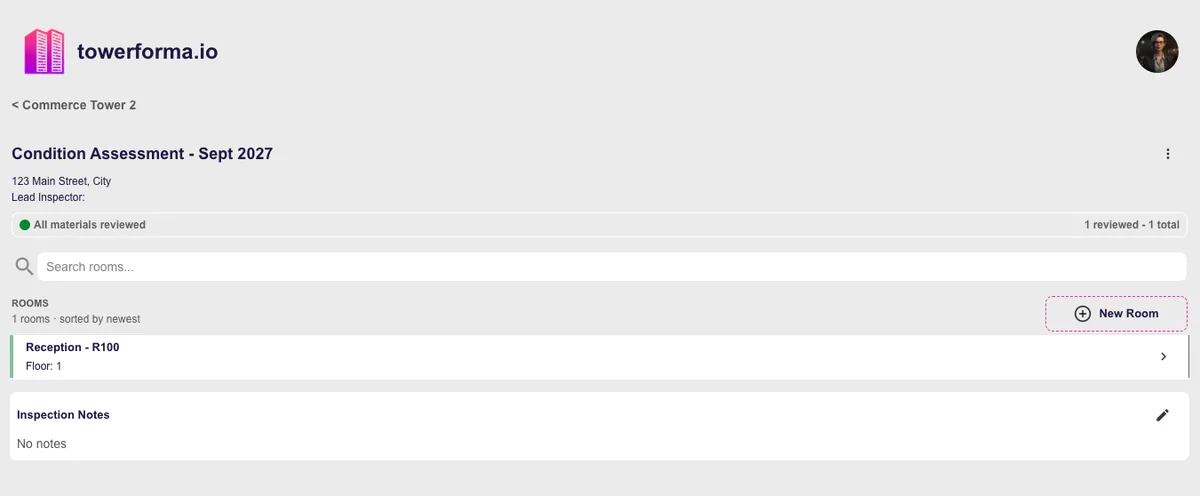
- Inspection history is visible per building, in date order.
- Superseded entries stay legible instead of being silently overwritten.
- Nothing depends on a specific person remembering which report was the authoritative one.
Updates
Update inventories as work occurs.
Most inventories fail quietly: they are accurate on the day they are delivered and slightly less accurate every month afterwards. Updating has to be a small task, not a project.
After abatement
Record removals against the specific occurrence so remaining materials stay distinguishable from removed ones.
After renovation
New finishes, reconfigured rooms and newly exposed materials update the existing structure.
After additional sampling
Assumed entries can be confirmed or cleared with the result recorded in place.
After reinspection
Condition reassessments update the material record rather than creating a parallel document.
During projects
Information captured during a small project scope contributes to the building record instead of vanishing into a project folder.
On handover
When consultants change, the building record is what transfers — not just the archive.
Facilities teams
Give facilities teams information they can actually use.
Internal teams ask location questions under time pressure, usually with a contractor waiting. They need a specific answer about a specific room, with a photograph.
Instead of: read the report
Open a report, check the scope section, find the room in an appendix table, cross-reference a sample identifier against a laboratory report, then look for a photograph in a separate appendix.
This: open the room
Go to the building, the floor, the room. See its documented materials, their status, their results and their photographs on one record — and where professional interpretation is needed, bring that record to your consultant.
Portfolio
Portfolio-level organization.
Universities, health authorities, school boards and property groups manage dozens of buildings with decades of overlapping assessment history. Structure at the portfolio level is what makes that history usable.
Sites and buildings
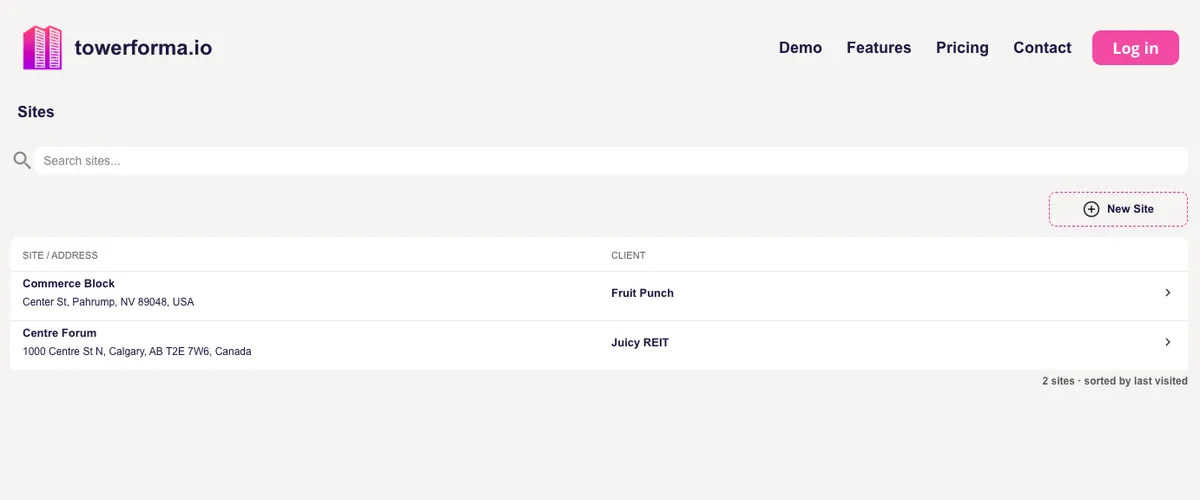
Buildings grouped by client, campus or portfolio, each with its own inspection history.
Consistent structure
Every building uses the same floor, room and material hierarchy, so comparisons are possible.
Multi-user access
Consultants and internal staff contribute to the same records with application-level access controls.
For the underlying inventory model, see hazardous materials inventory software or read the inventory guide.
Questions
Frequently asked
- How is this different from asbestos survey software?
- Survey software supports performing the assessment. Management software is about the years afterwards: knowing where identified materials are, keeping their evidence attached, and updating records as buildings change. Towerforma covers both, but the needs are different.
- Does Towerforma tell us whether we are compliant?
- No. Towerforma does not make regulatory determinations. It keeps the underlying information organized and retrievable so that your consultants and internal teams can apply the requirements that govern your jurisdiction and building type.
- Can we record assumed materials that were never sampled?
- Yes, and the assumed status stays explicit on the record. Assumed, sampled and confirmed entries are distinguishable, so later sampling can upgrade an entry without rewriting its history.
- What happens after abatement?
- The material record is updated to reflect the removal while the prior assessment, analytical results and photographs remain attached, so the building's history is still legible.
- Can facilities staff use it without being consultants?
- The records are organized by building, floor and room rather than by report, which is the way facilities teams ask questions. Interpretation of assessment findings should still involve a qualified consultant.
- Does it work for hazards other than asbestos?
- Yes. Lead-containing coatings, PCBs, mercury components, ozone-depleting substances and other hazardous building materials use the same room and material structure where they are within project scope.
Early access
Stop rediscovering what you already assessed.
Towerforma is in pre-launch development with hazardous materials professionals and institutional building owners. Join the early access list for product updates and testing opportunities.