
Hazardous materials inventory software
Hazardous materials inventory software for buildings
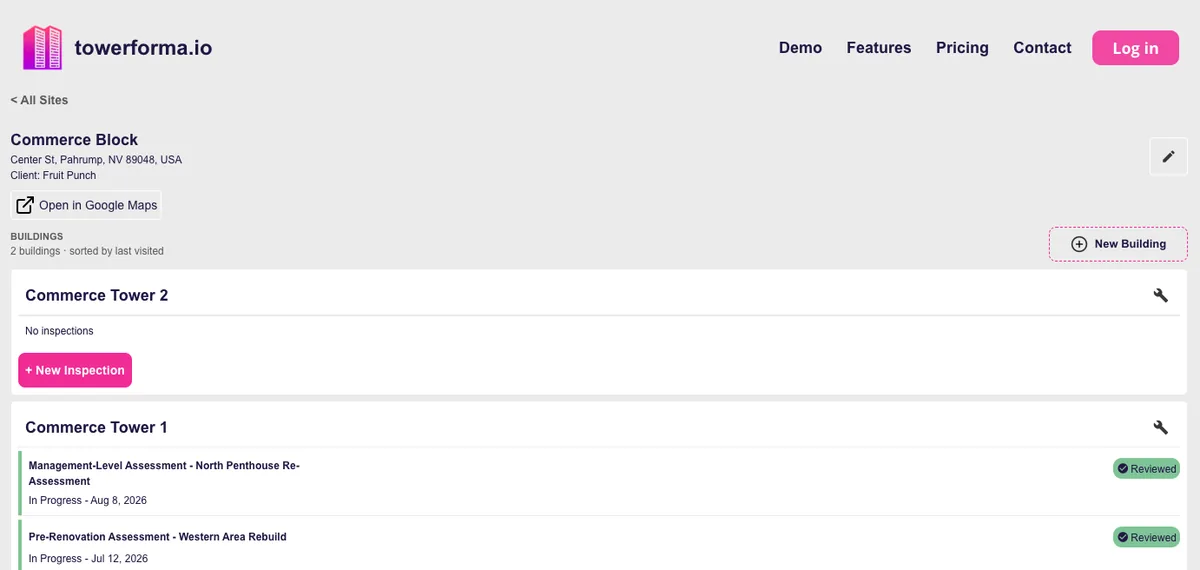
Towerforma holds a structured, location-based record of the hazardous materials in a building: organized by floor and room, with hazard status, sample and result history, and photographs attached to the material they document.
The report is a snapshot. The inventory keeps living.
- Building → floor → room → material structure
- Assessment and analytical history preserved
- Records updated as buildings change
- Portfolio-wide visibility across many buildings
Pre-launch · In development with hazardous materials professionals
Why it degrades
Hazardous material information gets harder to use every year it exists.
Nothing dramatic goes wrong. A building simply accumulates assessments performed by different consultants, in different formats, for different project scopes — and each one is stored as a document rather than as data.
The answer exists, somewhere
The question is usually simple — is there asbestos in this ceiling? — but answering it means finding the right report, opening it, and reading a table that was never meant to be searched.
Overlapping surveys
A pre-renovation assessment, a full building survey and a small project scope may all cover the same room and disagree in wording, coverage and date.
Outdated entries
Materials get removed during renovations, but the report that described them stays on file, unchanged, and keeps being circulated.
Consultants change
When a firm changes, the working knowledge of the building leaves with it. Only the documents remain, and documents do not explain themselves.
Photos become orphans
Photographs are usually the fastest way to identify a material later, and they are typically the first thing to lose its connection to a room.
Repeat assessments
When previous information cannot be retrieved with confidence, the practical answer is to assess again — paying twice for the same knowledge.
Structure
A structured record for every building.
The hierarchy is the point. A hazardous material only means something in a place, and a place only means something inside a building.
Portfolio
Clients and sites
Building
Address, inspections
Floor
Levels and areas
Room
Space, photos, finishes
Material
Occurrence records
Evidence
Samples, results, dates
Because every material occurrence is recorded inside a room, inside a floor, inside a building, a question about one ceiling tile has one place to be answered — and the same structure supports a question about every ceiling tile in the portfolio.
This is also why the inventory survives changes in consultant, staff or document management system: the organizing logic belongs to the building, not to a file naming convention.
Material records
Room and material-level information.
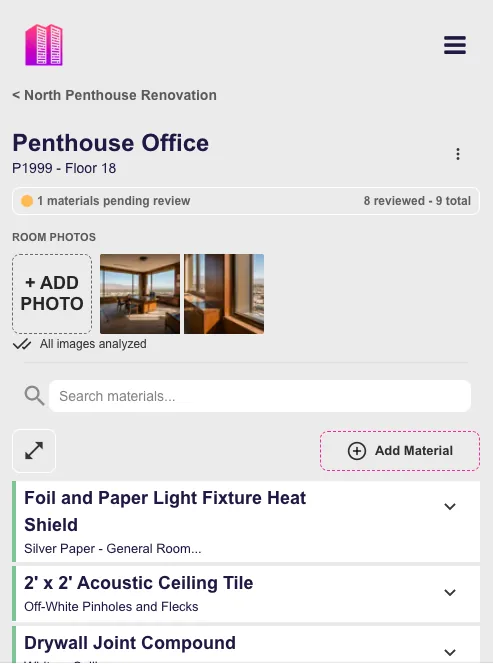
Each material occurrence is its own record rather than a row in a report table, which is what makes status, evidence and history possible to maintain.
Material and description
Material type plus the description a surveyor actually used, kept consistent across rooms.
Specific location
Where in the room the material occurs, so a later visitor can find it without guessing.
Hazard assessed
Which hazard the record relates to — asbestos, lead, PCBs, mercury and others within project scope.
Assumed, sampled, confirmed
Status stays explicit, so assumed materials are never quietly treated as confirmed.
Condition observations
Damage or deterioration recorded against the material, not buried in a general note.
Photographs
Images stay attached to the occurrence, which is usually the fastest way to recognize a material years later.
History
Preserve assessment and analytical history.
An inventory that only shows the current state loses the evidence. An inventory that only shows history is unusable. Both need to be present on the same record.
Results stay with the material
The analytical result is part of the material record, not a separate laboratory report that has to be located and matched.
Assessment dates and source
Each entry carries when it was assessed and which inspection it came from, so age and provenance are visible.
Multiple inspections, one building
Successive assessments build up on the same building rather than sitting side by side as unrelated deliverables.
Superseded information stays legible
When an entry is updated, what it said before remains part of the building's record.
Change
Maintain records as buildings change.
Buildings are renovated, materials are abated, tenants reconfigure floors. An inventory earns its keep only if updating it is easier than commissioning a fresh survey.
Removal and abatement
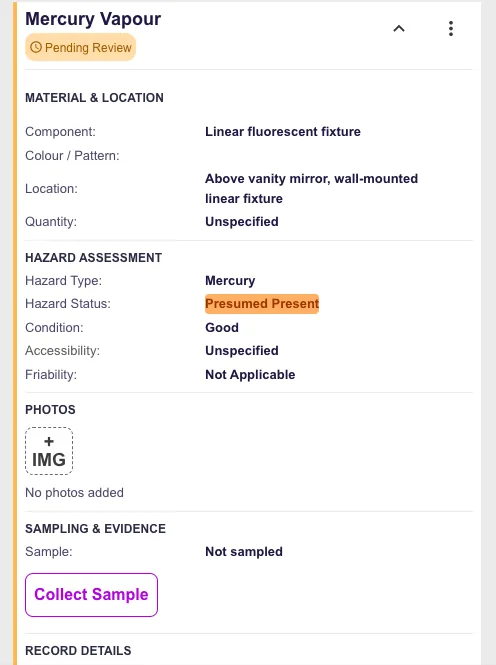
Mark materials removed while keeping the record of what was there and what it was confirmed to contain.
Reassessment
New inspections update existing occurrences instead of duplicating them under a different description.
Renovation scope
Project-scoped assessments feed the same building record rather than becoming another isolated PDF.
New areas
Add floors, rooms and areas as buildings are extended or reconfigured.
Additional sampling
Later sampling attaches to the existing material occurrence, so assumed entries can become confirmed over time.
Condition changes
Update condition observations when a material deteriorates or is repaired.
Portfolio
Visibility across many buildings.
Institutional owners rarely have a single building problem. They have forty buildings, twenty years of assessments and no consistent way to ask a portfolio-level question.
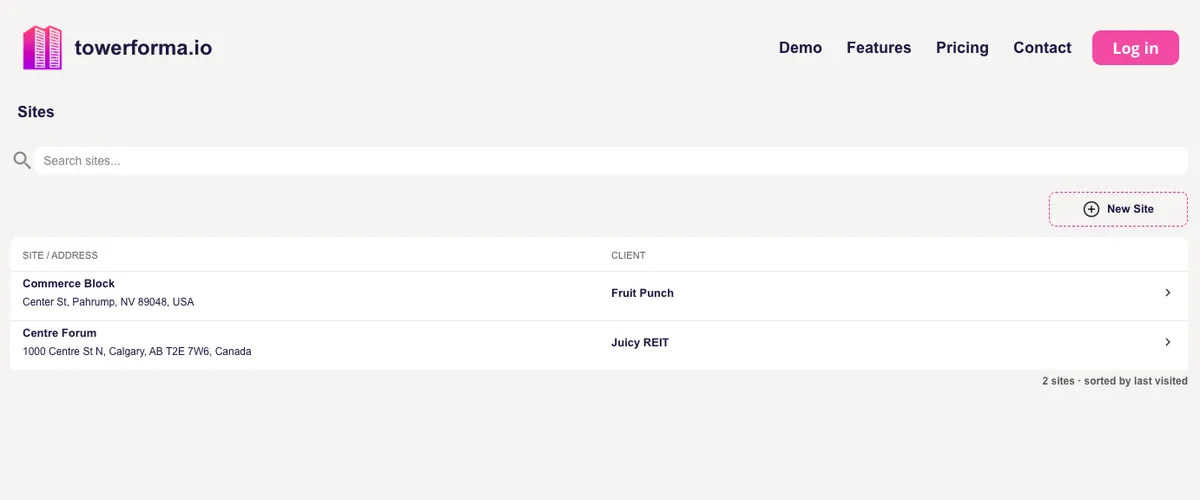
- Sites and buildings organized by client or portfolio.
- Inspection history visible per building rather than per document folder.
- Material records comparable between buildings because they share a structure.
- Structured exports when information has to move into other systems.
Portfolio-scale management after materials have been identified is covered on the asbestos management software page.
Handover
Consultant-to-owner handover, without the drop-off.
Most information loss happens at handover. The consultant knows the building in detail; the owner receives a document that compresses that knowledge into prose and tables.
What the consultant keeps
Authorship of the assessment, professional judgement, the formal report and the client relationship. Towerforma does not sit between the two — it is where the survey data lives while the work is done.
What the owner gains
A structured building record they can search, hand to a contractor, or give to the next consultant — which usually shortens the next scope rather than repeating it.
Reports vs inventories
A PDF is a fine deliverable and a poor database.
This is not an argument against reports. Reports are required, defensible and often contractual. The problem is asking a static document to serve as a facility's long-term data store.
The report
Fixed at a date. Carries scope, methodology, limitations and professional interpretation. Authoritative for the assessment it documents.
The inventory
Current by design. Holds material-level entries, status, evidence and history. Answers location questions between projects.
Where reports struggle
Searching, reconciling overlapping surveys, reflecting removals, and being usable by facilities staff during a project.
Where inventories struggle
They are not a substitute for professional assessment, interpretation or recommendations — those still come from the consultant.
For a practical walkthrough of fields, structure and maintenance, read how to build a hazardous materials inventory. If you are performing the assessments yourself, start with asbestos survey software.
Questions
Frequently asked
- What is a hazardous materials inventory?
- A structured, queryable record of the hazardous building materials known or assumed to be present in a building, organized by location, with the assessment and analytical evidence behind each entry. It is distinct from a survey report, which documents one assessment on one date.
- Do we still need the consultant's report?
- Yes. The report carries scope, methodology, limitations, interpretation and recommendations, and it remains the professional deliverable. The inventory is the underlying data that stays useful after the report is filed.
- What happens when a material is removed?
- The material record is updated to reflect the removal while the earlier assessment and analytical history stay attached, so it remains clear what was present, what was confirmed and when it changed.
- Can records from several inspections live in one building record?
- Yes. Successive inspections add to the same building structure, so a building accumulates history instead of accumulating unrelated reports.
- Can a consultant hand an inventory over to a building owner?
- That is a core use case. Consultants build the record during assessment work, and the owner ends up with structured information about their building rather than only a document.
- How many buildings can be managed?
- Records are organized by client and site, so a single portfolio can hold many buildings, each with its own floors, rooms, materials and assessment history.
Early access
Give every building a record that outlives the report.
Towerforma is in pre-launch development with hazardous materials professionals and building owners. Join the early access list for product updates and testing opportunities.